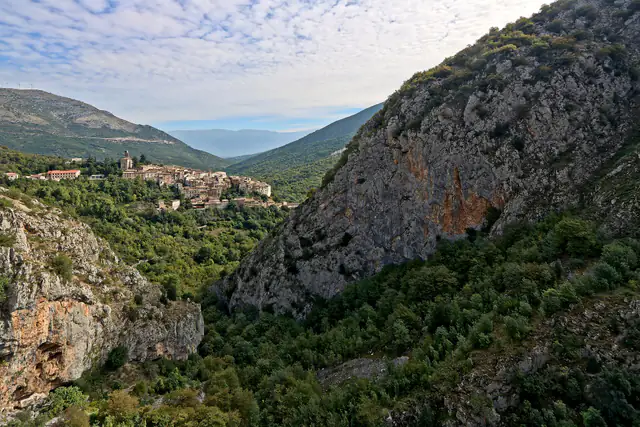
Anversa degli Abruzzi
AbruzzoA medieval village at the mouth of a gorge, with a sixteenth-century church that kept a stolen triptych and, a little above, a village suspended on…

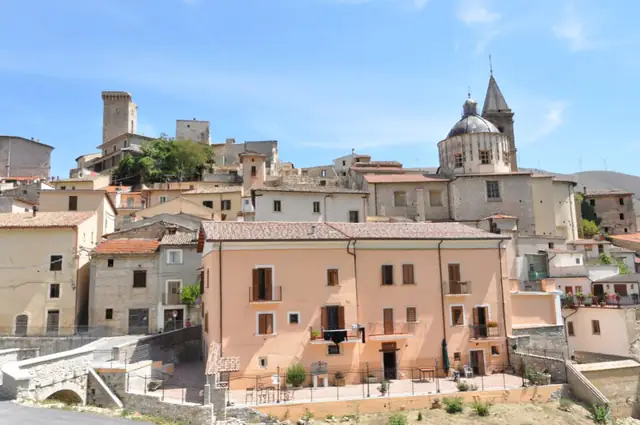
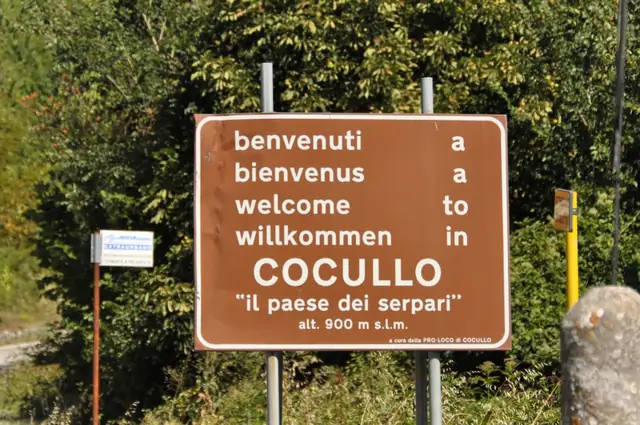
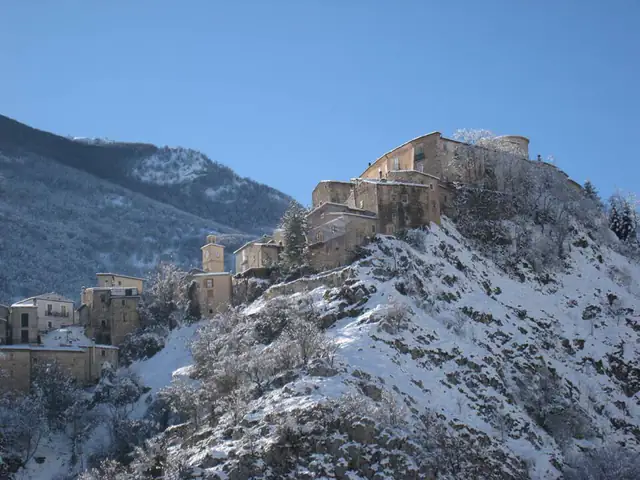
A village perched on a hill like an eagle's nest, with a medieval tower above the houses and, every year at the beginning of May, a procession in which the statue of a saint is covered with live snakes. Cocullo is the village of the festa dei serpari (festival of the snake handlers), the rite that for centuries has linked San Domenico to snakes.
A medieval village at the mouth of a gorge, with a sixteenth-century church that kept a stolen triptych and, a little above, a village suspended on…
A nature reserve as long as the river that carved it: limestone rock, water running along the bottom and woods climbing to almost fifteen hundred m…
A thirteenth-century church built over a Roman temple, with a Gothic façade and a radiating rose window.
The sacred breads distributed to the faithful during the festival, in memory of a miracle of the saint with flour.
The square stone keep, at the highest point of the village, with the walls and the two medieval gates.
The statue of San Domenico, covered in snakes, in procession.
A village perched on a hill like an eagle's nest, with a medieval tower above the houses and, every year at the beginning of May, a procession in which the statue of a saint is covered with live snakes. Cocullo is the village of the festa dei serpari (festival of the snake handlers), the rite that for centuries has linked San Domenico to snakes.
It is the village to which the story of San Domenico of Villalago naturally leads: the saint who lived in a cave on the lake, according to tradition, fled from Villalago and arrived here, and here left the relics with which he is still venerated today. But Cocullo has a story older than his, made of borders, ancient peoples and a cult that Christians clothed in sanctity.
Cocullo stands on a hill, the last southern offshoot of Monte Catini (1,319 metres), on the border between the Valle Peligna and the Marsica, in the upper Sagittario valley. From Scanno you reach it by the SR 479, passing through Villalago, Castrovalva and Anversa degli Abruzzi. From the A25 motorway there is a nearby exit, and the Rome-Sulmona-Pescara railway has a station about a kilometre from the centre.
The yellow route follows the roads and links Cocullo to nearby places; the dotted line is the short connection from the road to the place.
Data: © OpenStreetMap contributors (ODbL) · Relief from AWS Terrain Tiles (SRTM, EU-DEM and other open sources).The village is very ancient. It lies on the border between the Marsi and the Peligni, two Italic peoples, and was probably founded by one or both. The Greek geographer Strabo calls it Koukolon and the Romans Cuculum; it was conquered by Rome in the Social War and rebuilt as a staging post in the pass that separates the Marsica from the Valle Peligna. The original nucleus can still be seen in the Casale district, which today is the hamlet.
After the fall of the empire the population climbed back up the hill, where the Lombards founded a small fortified garrison with a watchtower. The village then passed under the counts of Celano and the Piccolomini, and until the abolition of feudalism had different lords.
The festival of San Domenico abate, called the festa dei serpari, is held in Cocullo at the beginning of May. Historically it fell on the first Thursday of the month; today it is celebrated on the first of May.
In the days and weeks before the festival, and at dawn on the day itself, the ciaralli, the snake hunters, go into the wood around the village to catch snakes, generally the four-lined snakes (cervoni), which tradition calls pasturavàcche and which were believed to suck the cows' milk. The snakes are brought to the village in special baskets and, after mass, are divided: one part decorates the saint's statue, carried in procession, another is offered to the faithful and tourists, who can wrap them round their necks during the procession. At the end of the ceremony the snakes are released in the wood.
During the festival the faithful ring the church bell by pulling its rope with their teeth, as a gesture of protection, and sacred breads, the ciambellati, are distributed, in memory of another miracle of the saint. Once snakes also entered the church and reached the altar; the rite was later forbidden by the Church in the twentieth century.
Tradition tells that San Domenico, after performing in Villalago the miracle of the wolf that returned a child, was threatened with death and fled towards Cocullo, placing a bear in front of the gates so that the village would not be sacked. He stayed seven years and in gratitude left the villagers two relics, a molar and the iron shoe of his mule, which served to protect against snake bites and toothache.
In the village's sanctuary there is a small natural cave from which the faithful take the “blessed earth” of San Domenico, which is scattered on the fields to protect them. Those who want to retrace the saint's story can combine Cocullo with the places of Villalago: the Hermitage of San Domenico and Lake San Domenico.
According to tradition the origin of the festival is much older than Christianity: it would go back to the cult of the goddess Angizia (Angitia), venerated by the Marsi, who knew how to master fire and snakes. The Romans called the Marsi healers and magicians, able to use snake venom. With Christianity, the figure of San Domenico was associated with this very ancient cult, which thus took on a Christian protective value.
The festival was then studied a great deal, and for a long time: by the local anthropologist Antonio De Nino, then by Alfonso Maria Di Nola; the painter Francesco Paolo Michetti painted it and D'Annunzio told of it in the tragedy La fiaccola sotto il moggio (The Torch Under the Bushel).
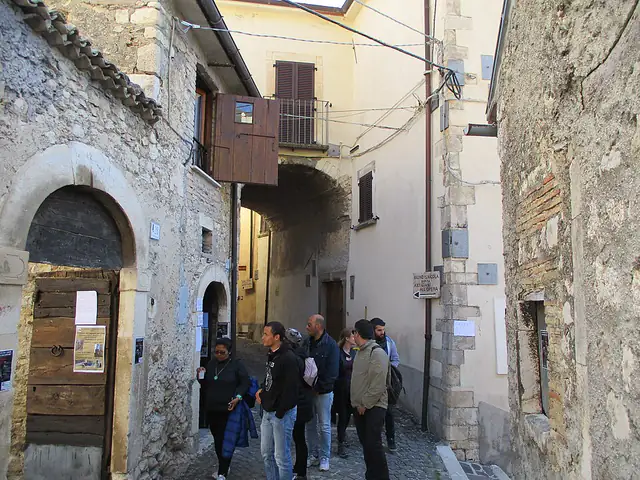
The old town is explored on foot along the route of the procession, starting from the sanctuary. In the highest part is the medieval tower of San Nicola, of which the square stone keep remains, later turned into a bell tower; the oldest walls and two gates, Porta di Manno and Porta Ruggeri, give access to the medieval village up a steep staircase. In the village there are also a thirteenth-century fountain, which served as a drinking trough and washhouse, and Casa Marano, a seventeenth-century palace where the philosopher Giambattista Gentile was born in the nineteenth century.
The sanctuary of San Domenico has a large dome and a bell tower with a pyramidal cusp and was built in the sixteenth century, first dedicated to Sant'Egidio and then to San Domenico; it keeps the bell pulled with the teeth. The church of the Madonna delle Grazie, from the thirteenth century, stands on a Roman temple and has a Gothic façade with a radiating rose window and a sixteenth-century side portal.
In the Casale hamlet there is the little church of Santa Maria in Campo, of very ancient origins, with Romanesque traces: in mid-August the statue of the Madonna Assunta is carried in procession.
The village has a documentation centre for folk traditions, created to gather the study material on the serpari festival and on Abruzzo traditions, with a library of cultural anthropology and a multimedia room with period footage.
From Cocullo you go down to Anversa degli Abruzzi, the gorges and Castrovalva, or continue towards Villalago and Scanno, along the same road.
The moment of the festival is the beginning of May, and it is best to arrive early: it is the day on which the village changes appearance. The rest of the year the village can be visited without hurry, from May to October; in mid-August, in the Casale hamlet, there is the procession of the Assunta. Month by month, below you will find what to expect.
The sacred breads distributed to the faithful during the festival, in memory of a miracle of the saint with flour.
A small village, with a lot to tell.
The square stone keep, at the highest point of the village, with the walls and the two medieval gates.
A thirteenth-century church, built over a Roman temple, with a Gothic façade and a radiating rose window.
The hamlet's little church, of very ancient origins and with Romanesque traces.
It gathers the study material on the serpari festival and on Abruzzo traditions, with a multimedia room.
The symbols and stories linked to San Domenico and the snakes.
The species used in the festival is the four-lined snake (cervone), which tradition calls pasturavàcche because it was believed to suck the cows' milk.
A molar and the iron shoe of the mule, left by the saint to the villagers to protect themselves from toothache and snake bites.
According to tradition the saint placed a bear in front of the gates to save Cocullo from being sacked.
According to tradition the festival comes from the Marsi cult of the goddess of fire and snakes, later Christianised.
Best time: in May. The bars show how well suited the month is: the taller, the better.
Winter at altitude: the village is quiet and is visited with a short walk.
Short days and few people: better a visit to the old town.
The thaw: the village prepares for the season.
The snake hunters begin searching in the wood: spring is at the door.
It is the month of the serpari festival, at the beginning of the month: the village changes appearance.
Festivals and traditions Serpari festival of San Domenico
The green is full and the village is explored without hurry.
Long days: a pleasant stop on a journey through the Sagittario valley.
In mid-August, in Casale, the procession of the Madonna Assunta.
Festivals and traditions Assunta procession in Casale
Soft light and fewer people: the village and walls can be looked at without hurry.
Autumn colours around the hill: excellent for a walk.
Short days: a quick visit.
Cold and short days: it is best to choose something else.
Postcards from the area, with the straight-line distance.
The season of the serpari festival, at the beginning of May.
Fewer people and autumn colours around the hill.
It is the festival of San Domenico abate: at the beginning of May the saint's statue, covered in snakes, is carried in procession through the village.
Read more: The festa dei serpari (festival of the snake handlers)At the beginning of May: historically the first Thursday of the month, today the first of May.
Read more: The festa dei serpari (festival of the snake handlers)They are the snake hunters who, before and on the day of the festival, go into the wood to catch snakes, which are then released at the end of the rite.
Read more: The festa dei serpari (festival of the snake handlers)Because tradition says he left in Cocullo relics that protect against snake bites and toothache; the rite is also linked to the more ancient cult of the goddess Angizia.
Read more: San Domenico in CoculloAccording to tradition San Domenico lived in a cave at Villalago and, threatened, fled to Cocullo, where he stayed seven years.
Read more: San Domenico in CoculloThey are the sacred breads distributed to the faithful during the festival, in memory of a miracle of the saint.
Read more: The festa dei serpari (festival of the snake handlers)It is a gesture of protection linked to the saint, repeated every year: the faithful pull the bell's rope with their teeth, on the day of the festival.
Read more: The festa dei serpari (festival of the snake handlers)The tower of San Nicola with the walls and gates of the village, the churches of San Domenico and the Madonna delle Grazie, the thirteenth-century fountain and the documentation centre.
Read more: The eagle's-nest villageFrom the SR 479, passing through Anversa; from Scanno through Villalago and Castrovalva; from the A25 motorway there is a nearby exit, and the railway has a station about a kilometre away.
Read more: Where Cocullo is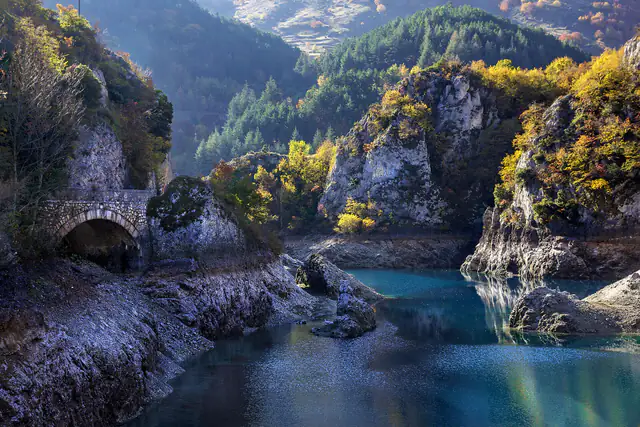
 11 km
 11 km
 12 km
 13 km
 14 km
 16 km
 17 km